
Ultimate Guide: Snowboarding for Beginners
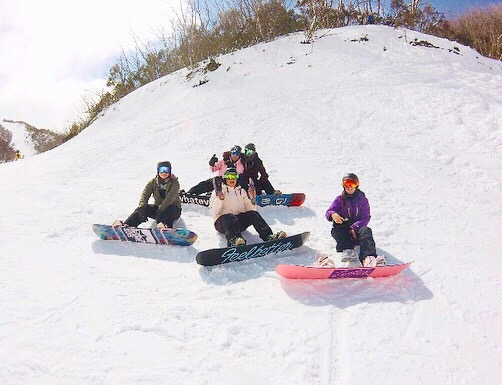
They say skiing is easy to learn, hard to master and snowboarding is hard to learn, easy to master. So if you’re ready to learn, just know, snowboarding can be really hard to start off with especially when you’re falling over and if you’re not riding consistently. Trust me when I say that once you get it, it’s awesome, and can take you all over the world. Keep in mind that snowboarding is an extreme sport. This means you can get hurt, especially if you are a beginner. For all the newbies out there, here is the ultimate guide for your first day on the snow.
Things you’ll need: Snowboard, bindings, snowboard boots, warm waterproof clothing, goggles, gloves, a helmet (a must) and any other protective wear, we recommend wrist guards and impact shorts.
You can hire or buy all the items you need from Oz Extreme.
Stance – Regular or Goofy?
Regular means that your left foot is forward when going downhill, and goofy means that your right foot is forward. If you have experience with skateboarding or surfing, you can use the stance you’re comfortable with. To determine your dominant foot grab a friend and do this little test. Stand with your feet shoulder-width apart and be gently pushed from behind. The foot you use to step forward should be your front foot when snowboarding. As you progress, you can also learn to ride “switch” with your non-dominant foot forward.

Skating
This is great way to get used to movements required for boarding and how you’ll get around on flats or the bottom of the lift. Strap your front foot into the binding while leaving your other foot free. Start behind the board (don’t do it in front, it’s awkward) and use your free foot to push off the snow and glide across it. Initially, start with small pushes, similar to walking. Gradually increase your push-off force and gliding distance as you become more comfortable. When traveling longer distances, place your foot on the stomp pad, located between the bindings. Practice this technique until you feel confident before attempting to get on the lift.
The Lift
Getting on – Skate into the line for the lift and ask the lift operators (Lifties) for help if you need it. When it’s your turn, skate up to the indicated lift boarding line. Wait for the chair to come up behind you, sit down, pull down the bar and Relax and enjoy the ride.
Getting off – When you’re approaching the end of the lift, turn your body so that the front of your board is facing the ramp off the lift. Lift your board, let it hit the snow, and push off the chair to stand up on the board. Your front foot should be strapped in, and your back foot should be on the stomp pad. Glide down the ramp on the board until you come to a stop. Try to get out of the way of the people behind you as the next chair is very close behind you. If you fall, STAY DOWN! Don’t sit up right away or you might get hit by the chair. Listen to the Lifties instructions.
Use this video for more help!
Snowboarding
Stance and Balance
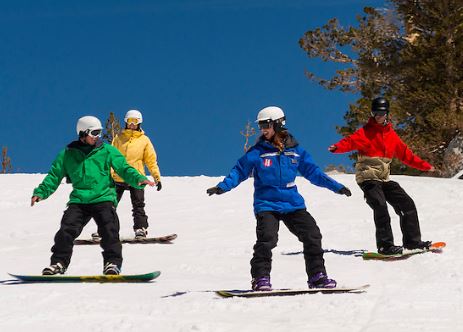
Falling Leaf – At the top of the hill, sit down and strap in your other foot. Then, stand up, keeping your weight even between your two feet, but leaning back on the heel edge of your board. You should be standing up and still. Shift your weight toward your front foot, and slightly off your heel edge, and you’ll start to move toward your front foot. Shift your weight toward your other foot and you’ll slow down and then move in that direction. Keep repeating this, and you’ll slide down the hill in a falling leaf motion.
Regular Riding – Stand up, and put your weight on your front foot, not leaning on either edge. This will propel you straight down the hill. Ride with your knees bent slightly, and always have your weight over your front foot.
Slowing down and stopping
To slow down, lean onto your heel edge, and move your weight towards your back foot. This will turn your board perpendicular to the mountain, and dig heel edge into the snow to slow you down. Keep your knees bent to make a smooth stop. Always slow down and stop if you think you are starting to get to an out-of-control speed. You are responsible for avoiding riders downhill from you, so do not run them over. Always board in a safe, defensive manner, or ski patrol may take away your lift ticket (which is lame).

Turning
Turning is easy in theory but definitely takes practice to do accurately. When riding down the hill with your weight on your front foot, simply lean onto your heel edge and keep your weight on your front foot to perform a heel-side turn. When you have turned far enough, stop leaning on your heel edge. A toe-side turn is performed the same way, but lean on your toe edge. Toe-side turns are usually more difficult for beginners. If you point your front arm the direction you want to turn, you will turn more naturally.
Falling
You will fall as a beginner. A lot! It’s okay. When you do fall, there are a couple techniques that will stop you from getting as hurt. First, do not extend your hands to catch yourself. The most common beginning-snowboard injury is a broken wrist because so many people have this bad habit. Instead, make a fist with each hand and land on your forearms. This will protect your wrists and also spread the impact out, making it easier on your body. Also, if you fall backwards, pick a butt cheek to land on. You want to avoid a painful landing on your tailbone, and the padding provided by your butt will do just that. Lastly, after you fall, it is your responsibility to look up the mountain to make sure it’s clear when you get back up.
We recommend…
Find a friend and learn together. It will be more fun and you are less likely to get discouraged.
Get a lift and lesson pass, it’s cheaper and you can learn the basics to extreme riding from the experts on the hill!
Hire your gear the first time, then start to buy your own gear when you start heading up the mountain more often. Oz Extreme has snowboards for hire. To give you an idea of the board length you will need refer to our size guide.